

The Green Light Problem
I’m Waiting for It": Skin Tone Bias and the Optical Gap
My toddler keeps talking about her father’s “green” - the small green light on the underside of his smartwatch. Look at yours while it is tracking metrics, and you’ll see it. That's photoplethysmography, PPG. It works by pushing light into the skin and measuring how much bounces back as blood pulses through. Your heart rate, your heart rate variability: it all starts with a light.
Melanin absorbs light. The more melanin in the skin, the more of that light is absorbed before it reaches the blood, and the weaker the signal the sensor has to work with. This isn’t a manufacturing flaw or a bad batch. It’s optics. Skin tone bias in PPG isn’t a possibility to rule out. It’s a default to design against, and then prove you’ve beaten it.
With sex differences, the physiology is real, but the measurement bias is subtle. With skin tone, the measurement bias is documented, large, and clinically dangerous, and SensorFM is built squarely on the signal where it can show up worst.
Two lights, two problems
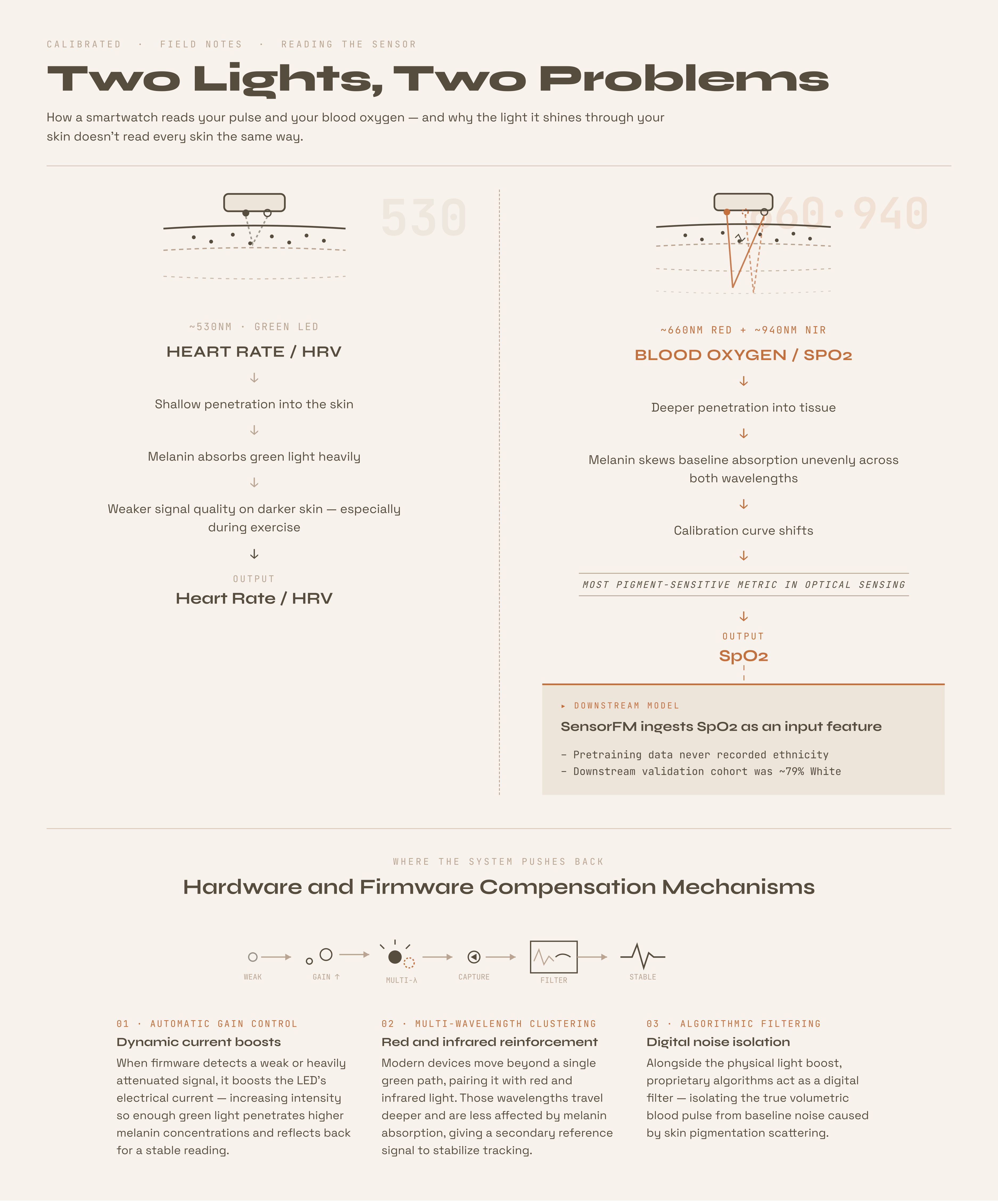
Consumer devices don’t use one wavelength for everything. Green light (around 530nm) handles heart rate and HRV. It’s used because it gives a strong AC signal during movement, which is what continuous tracking needs. But epidermal melanin absorbs green light heavily, which degrades signal-to-noise on darker skin, especially under exercise.
Red (around 660nm) and near-infrared (around 940nm) handle SpO₂. Oxygenated and deoxygenated haemoglobin absorb these wavelengths at different rates, which is what lets a device calculate oxygen saturation via a ratio-of-ratios calculation. Melanin alters baseline attenuation across both wavelengths unevenly, which skews the calibration curve the SpO₂ estimate depends on.
That’s why SpO₂, not heart rate, is the single most pigment-sensitive metric in optical sensing.
What does the evidence say?
Pulse oximeters, the fingertip kind, in every hospital, estimate blood oxygen using the same optical principle as your watch. And they are less accurate on darker skin, in a way that causes harm.
The clinical wake-up call came in 2020. A landmark NEJM study found hospital pulse oximeters missed hypoxemia roughly three times as often in Black patients as in White patients at the same reading (Sjoding et al. 2020). That paper is the reason pulse oximetry skin tone bias moved from academic finding to FDA-level concern over the following five years, and it's the reason wearables and foundation models built on the same optical signal need to compensate for this bias.
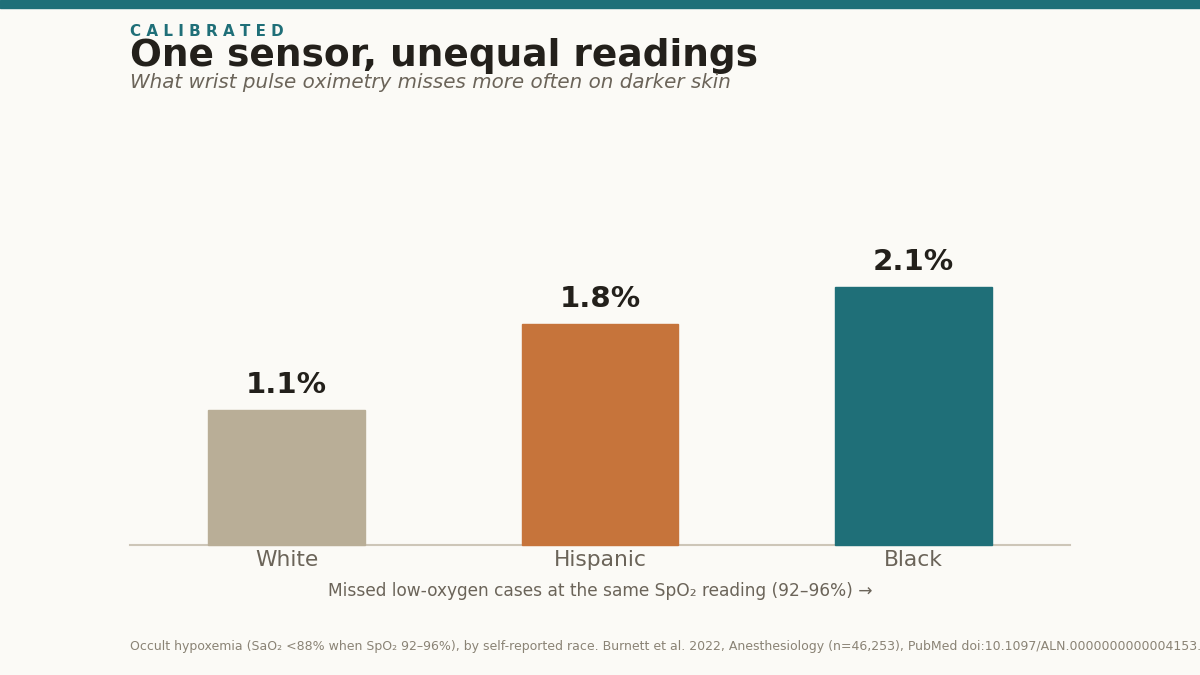
The larger cohort studies since confirm the pattern. Occult hypoxemia, a reassuring oximeter reading while actual blood oxygen is dangerously low, occurred at the same reading in 2.1% of Black and 1.8% of Hispanic patients, versus 1.1% of White patients, in a study of over 46,000 patients (Burnett et al. 2022). A separate cohort of over 36,000 ICU patients found Black patients over-represented in oximeter discrepancies and occult hypoxemia, and, critically, that those discrepancies tracked worse outcomes: longer ICU stays and higher mortality (Saidy et al. 2025). Same reading, different risk.
Now the constructive half, because it matters. A device engineered and calibrated on a balanced range of skin tones can close the gap: Masimo’s own laboratory data, on healthy Black and White volunteers taken down through hypoxia, show no clinically significant racial difference in accuracy (Barker & Wilson 2022). Read that as proof it’s solvable, not proof it’s solved everywhere, since it’s industry-authored. But the direction is the point. Inclusive calibration works. The bias is a design choice, not a destiny.
The consumer gap
Hospital oximeters are regulated medical devices with clearance requirements. Consumer wrist wearables are not held to the same bar, and it shows. Independent testing finds wrist heart rate accuracy that is generally fine at rest but degrades during exercise, and degrades more on darker skin, with large differences between brands. Some devices stay within a few beats per minute across skin tones; others drift by 10 to 15bpm at rest and worse under exertion (systematic review; Fitzpatrick-stratified device studies).
To be fair to the field, some validations do the right thing and pass. A machine learning wrist-PPG algorithm tested with an explicit skin tone subgroup, roughly a quarter of the sample at Fitzpatrick V to VI, met its accuracy threshold across skin tones (Chen et al. 2024). That’s exactly the breakdown I want to see more of. The problem isn’t that no one can do this. It’s that it isn’t standard, so “validated” on a box tells you nothing about which validation you’re getting.
Manufacturers know about this and have responded, at least at the hardware level. Garmin and Fitbit have reportedly configured devices to boost green LED intensity when the sensor detects a weak signal, pushing more light through higher-melanin skin to recover a usable reading (govtech.com, 2021). Google’s own account of the Pixel Watch 2 and Fitbit Charge 6 redesign describes a multi-LED, multi-photodiode array built to cover more skin surface, with skin tone named explicitly as one of the variables the team tested against during development (Google, 2023). That’s a real engineering response, not a marketing claim, and it’s worth crediting.
It doesn’t fully close the gap. A Monte Carlo modelling study of the Apple Watch Series 5, Fitbit Versa 2, and Polar M600 found that increasing skin tone and BMI together can still produce a theoretical signal loss of up to 61% in the Fitbit Versa 2 and around 32% in the other two devices, even accounting for the sensor geometry manufacturers use (Ajmal et al. 2021). A separate study on a commercial wearable found skin tone was the only significant predictor of heart rate accuracy at rest and while walking, tattoos included (Koerber et al. 2022 systematic review; tattoo-specific study, 2024). Compensation helps. It doesn’t make skin tone stop mattering, and none of these manufacturer mechanisms have been published with the kind of subgroup validation data that would let an outside reviewer check the claim.
There’s a plausible mechanical reason compensation degrades under motion. “Cadence lock”, where the sensor’s algorithm mistakes the rhythmic motion of a stride for the pulse signal, is a well-documented PPG failure mode, acknowledged even in manufacturer forums. Whether melanin-driven LED intensity boosting specifically worsens cadence lock isn’t something I’ve found stated in any published source. It’s a reasonable hypothesis given the underlying physics, not an established finding, and I’m flagging it as such rather than asserting it.
The regulatory gap this all sits inside is now moving, at least on the clinical side. The FDA published draft guidance in January 2025 requiring pulse oximeter manufacturers to test accuracy across skin pigmentation groups, using the Monk Skin Tone scale and a spectrophotometric measure (Individual Typology Angle) rather than self-reported race, with minimum sample sizes and explicit error thresholds. That guidance applies to medical pulse oximeters. Consumer wearables, classified as wellness devices, sit outside it entirely. The regulatory bar clinicians are about to hold hospital oximeters to has no equivalent for the device on your wrist.
Back to SensorFM
SensorFM’s inputs include SpO2, derived from PPG, the single measurement with the strongest documented skin tone bias in sensing. Its pretraining cohort, the trillion minutes, five million people, never recorded ethnicity: unrecorded, not merely un-analysed. Its downstream validation cohort, the phenotyped 13,985 used to prove the tasks, is about 79% White. The authors name the limitation themselves: the data “is skewed towards... White/Caucasians,” and performance “may not generalize directly to the overall population.”
Worth being precise about the pipeline: the entire pretraining set comes from Fitbit and Pixel Watch devices, over 20 models, exclusively, and the model doesn’t ingest raw PPG. It takes 34 pre-processed one-minute aggregate features, computed on-device. So the SpO2 reaching SensorFM has already passed through Fitbit and Pixel Watch’s own compensation, the dynamic LED boosting and multi-wavelength array covered above. It isn’t raw, uncorrected signal. But that compensation is documented as incomplete, so the aggregate feature still carries some residual, unquantified bias from the hardware layer beneath it. What’s undisclosed is whether any signal quality flag travels with those 34 features, so the model has no visible way to distinguish a degraded reading from a clean one. That’s the specific, answerable question left, and it belongs to the authors.
Worth pre-empting the standard defence: that self-supervised pretraining on massive data lets a model learn invariant representations regardless of demographic labels. That doesn’t hold for a signal-to-noise problem. Self-supervision cannot extract signal from noise that was never captured cleanly, so the pretrained representation for darker-skinned cohorts is built on a systematically noisier distribution, a bias that propagates rather than disappears at scale, and compounds at fine-tuning on a 79% White cohort.
None of this is inference. It’s the paper’s own disclosure, and it deserves the same weight as the headline result. A model built on the most pigment-sensitive signal available, trained on data that didn’t record pigment and validated on a mostly-White cohort, is making a claim about “human physiology” its own evidence base can’t yet check against most of the humans.
What I’d want to see next
Report SpO₂ and heart rate task performance by Fitzpatrick skin type, the way the best consumer validations already do. Worth noting the Fitzpatrick scale was designed in 1975 for UV sun-reactivity, not optical absorbance at green or red/NIR wavelengths. It’s the current industry standard for subgroup reporting, but the Monk Skin Tone scale and direct spectrophotometric measures like Individual Typology Angle are becoming the better fit for optical validation specifically.
Record skin tone in future data collection. You cannot audit what you never measured. The pretraining “n.c.” is the thing to change first.
Validate beyond a roughly 79% White cohort before the phrase “general-purpose representation of human physiology” does load-bearing work.
Disclose whether the model ingests raw or pre-processed PPG, and whether any signal quality gating exists.
Apply something like the FDA’s Monk Skin Tone / ITA testing standard, currently proposed for medical pulse oximeters, to the consumer-grade SpO2 feeding into this model. Nothing requires SensorFM to meet a clinical regulatory bar. But borrowing its testing standard voluntarily would be the single fastest way to answer the question this whole post is asking.
None of these needs new science. The Masimo data show the underlying problem yields to inclusive calibration. The Chen et al. validation shows the reporting is routine when someone decides to do it. This is the post in the series where the ask is clearest and the precedent already exists.
The green light is a genuinely clever piece of engineering. But it can only report what the light can see, and on darker skin, it sees less. A model that never checks whether that matters isn’t wrong, exactly. It just hasn’t earned the word “general” yet.
References
Sjoding MW, Dickson RP, Iwashyna TJ, Gay SE, Valley TS. Racial Bias in Pulse Oximetry Measurement. N Engl J Med. 2020;383(25):2477-2478. https://doi.org/10.1056/NEJMc2029240
Burnett GW, Stannard B, Swift MD, et al. Self-reported Race/Ethnicity and Intraoperative Occult Hypoxemia. Anesthesiology. 2022;136(5):688-696. https://doi.org/10.1097/ALN.0000000000004153
Saidy S, Adams C, Patel R, et al. Pulse Oximetry Discrepancies and Occult Hypoxemia in ICU Patients. J Intensive Care Med. 2025;40(12):1269-1278. https://doi.org/10.1177/08850666241280000
Barker SJ, Wilson WC. Racial effects on Masimo pulse oximetry: a laboratory study. J Clin Monit Comput. 2023;37(2):567-574. https://doi.org/10.1007/s10877-022-00927-w
Chen W, Liu Y, Zhang H, et al. Multicenter Evaluation of Machine-Learning Continuous Pulse Rate Algorithm on Wrist-Worn Device. Digit Biomark. 2024;8(1):218-228. https://doi.org/10.1159/000538910
Ajmal S, Boonya-Ananta T, Rodriguez AJ, Du Le VN, Ramella-Roman JC. Monte Carlo analysis of optical heart rate sensors in commercial wearables: the effect of skin tone and obesity on the PPG signal. Biomed Opt Express. 2021;12(12):7445-7457. https://doi.org/10.1364/BOE.439893
Koerber D, Khan S, Shamsheri T, Kirubarajan A, Mehta S. Accuracy of Heart Rate Measurement with Wrist-Worn Wearable Devices in Various Skin Tones: a Systematic Review. J Racial Ethn Health Disparities. 2023;10(5):2433-2445. https://doi.org/10.1007/s40615-022-01446-9
Colvonen PJ, DeYoung PN, Bosompra NO, Malhotra A. Limiting racial disparities and bias for wearable devices in health science research. Sleep. 2020;43(11):zsaa159. https://doi.org/10.1093/sleep/zsaa159
Food and Drug Administration. Pulse Oximeters for Medical Purposes: Non-Clinical and Clinical Performance Testing, Labeling, and Premarket Submission Recommendations (Draft Guidance). U.S. Department of Health and Human Services; 2025.
Lipnick MS, Ehie O, Igaga EN, Bicker P. Pulse Oximetry and Skin Pigmentation: New Guidance From the FDA. JAMA. 2025;333(16):1393-1395. https://doi.org/10.1001/jama.2025.2140
Narayanswamy G, Xu MA, Liu X, McDuff D, et al. Towards a General Intelligence and Interface for Wearable Health Data. arXiv preprint. 2026;arXiv:2605.22759v1. https://doi.org/10.48550/arXiv.2605.22759